


 Back
BackHow Much Does It Cost to Charter a Private Jet? A Simple Guide to Pricing
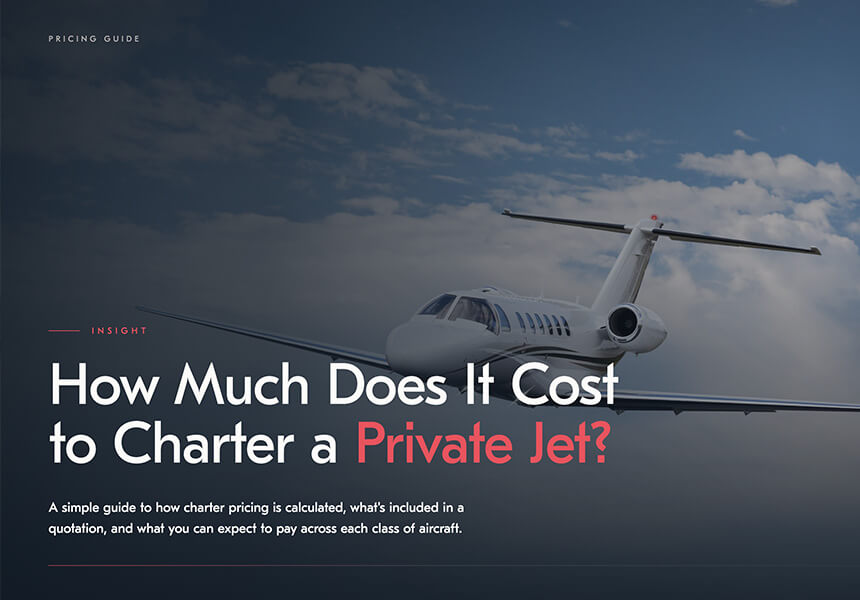
Chartering a private jet can feel like a mystery when it comes to pricing. Quotes vary, prices change, and it’s not always clear what you’re actually paying for. This guide breaks it down simply: how pricing is calculated, what’s included, and what you can expect to pay depending on the aircraft.
Note: The figures below are general market estimates intended to provide a realistic starting point. Actual pricing depends on the aircraft, route, operator, airport selection and timing, so always confirm costs with a live quotation.
How Charter Pricing Is Calculated
Most private jet charter pricing is built around an hourly flight rate, made up of two broad components.
The first is fixed operating costs, which typically account for around two-thirds of the total. These include fuel, aircraft lease or ownership costs, crew salaries and training, maintenance reserves, insurance and air navigation charges. These expenses exist whether the aircraft flies or not.
The second is variable trip costs, which account for roughly one-third of the overall price. These include airport handling, passenger taxes, catering, crew overnight accommodation and aircraft positioning costs.
This is why two seemingly identical flights can sometimes receive different quotations. The aircraft’s location, airport fees, tax liabilities and operational requirements all influence the final price.
Typical Hourly Charter Rates
As a general guide, these are the hourly charter rates you can expect across the market:
| Aircraft Category | Example Aircraft | Approx. Hourly Rate |
|---|---|---|
| Light Jet | Citation CJ3, Phenom 300 | £2,000–£3,550 |
| Midsize Jet | Citation Excel, Learjet 60 | £3,150–£5,150 |
| Super-Midsize Jet | Challenger 350, Citation Latitude | £4,350–£6,700 |
| Heavy Jet | Gulfstream G450, Falcon 900 | £5,550–£8,700 |
| Ultra-Long-Range | Global 6000, Gulfstream G650 | £7,100–£11,850+ |
While these hourly rates provide a useful benchmark, the final cost of a charter is always calculated based on the complete mission rather than simply multiplying the hourly rate by the flight time.
What Does a Typical Charter Actually Cost?
To put these figures into context, here are two popular European charter routes. These examples assume average market conditions and an aircraft positioned reasonably close to the departure airport. Actual pricing will always depend on aircraft availability, positioning, airport charges, taxes and the date of travel, but they provide a realistic indication of what you can expect to pay.
A flight from London to Nice is one of Europe’s busiest private jet routes, particularly throughout the summer and during major events on the French Riviera. A Light Jet such as a Citation CJ3 or ’super light' Phenom 300 will typically complete the journey in around 1hr50 mins, comfortably seating up to six passengers. Under normal market conditions, a one-way charter is likely to cost between EUR €13,000 and €17,000. During periods of exceptionally high demand such as the Monaco Grand Prix, Cannes Film Festival or peak summer weekends pricing can increase further as aircraft availability tightens and airports introduce additional parking, handling and operational charges.
For a longer journey such as London to Istanbul, a Super-Midsize Jet such as a Challenger 350 or Citation Latitude is often the preferred aircraft, combining excellent range with a spacious stand-up cabin and generous baggage capacity. The journey takes approximately 3 hours and 35 minutes, with a typical one-way charter costing between EUR €35,000.00 and €39,000.00. While the longer flight time naturally increases the cost, the larger aircraft also carries higher operating expenses, which are reflected in the overall price.
These examples highlight an important point: hourly rates are only part of the equation. Depending on aircraft positioning, airport choice, taxes and seasonal demand, quotations on exactly the same route can easily vary by around €6,000, making a live quotation the most accurate way to price any trip.
What Else Is Included in the Price?
Beyond the aircraft’s hourly rate, several additional costs typically appear within a charter quotation.
Landing and handling fees vary considerably between airports. A smaller regional airport may charge only a few hundred pounds, whereas a major international hub such as Heathrow can charge several thousand.
Catering is normally tailored to the flight. A simple selection of refreshments on a short sector may cost between £40 and £120 per passenger, while premium dining on longer flights can exceed £400 per person.
If the crew remain away from their home base overnight, accommodation and subsistence costs are usually charged, typically ranging from £120 to £320 per crew member per night.
During the winter months, de-icing may also be required. Depending on weather conditions and aircraft size, this can add anywhere between £160 and £1,200 to the charter.
Another important consideration is aircraft positioning, sometimes referred to as a ferry flight. If the aircraft is not already based near your departure airport, it must fly empty to collect you before your journey begins. Selecting an aircraft already positioned nearby can often reduce the overall charter cost significantly.
Many operators also apply a minimum daily flight time, often between one and two hours. This means that very short flights can appear comparatively expensive on a per-hour basis, as the aircraft and crew must still be available for the minimum operating period.
Taxes and Regulatory Costs
Government taxes can also form part of the overall charter price depending on where you fly.
In the United Kingdom, Air Passenger Duty (APD) applies to many private jet departures from UK airports. The amount payable depends on the aircraft, passenger capacity and destination.
In the United States, domestic private jet charters are subject to Federal Excise Tax (FET), currently charged at 7.5% of the charter cost, together with a small per-segment fee.
Italy also levies a luxury tax on many private aviation movements.
Meanwhile, France applies a solidarity tax to flights departing from French territory, which can add a noticeable amount to routes originating in France.
These charges are imposed by governments rather than brokers or operators, meaning they apply regardless of who arranges your flight.
What Drives the Price Up or Down?
Several operational factors have the greatest influence on the final charter price.
The location of the aircraft is often one of the biggest variables. An aircraft already based near your departure airport avoids expensive positioning flights, reducing the overall cost.
Airport choice also matters. Flying from a nearby regional airport rather than a busy international hub can lower landing, handling and parking fees while often providing greater aircraft availability and faster departures.
Booking further in advance generally provides access to a wider range of aircraft at more competitive rates, whereas last-minute bookings inevitably limit availability and can increase pricing.
Occasionally, travellers can take advantage of empty leg flights, where an aircraft already needs to reposition for another booking. These can offer substantial savings but are entirely dependent on existing schedules and should be viewed as an opportunity rather than relied upon.
The aircraft itself also affects pricing. Newer aircraft with the latest cabin interiors, upgraded technology and enhanced passenger amenities typically command higher charter rates.
Finally, special events and seasonal demand can have a significant impact. High-profile occasions such as the Monaco Grand Prix, Cannes Film Festival, the World Economic Forum in Davos, Wimbledon, Royal Ascot, the Cheltenham Festival, major football finals and peak ski weekends all increase demand for private aviation. During these periods, airport slots become more limited, parking charges increase, handling agents operate at capacity and aircraft availability tightens, all of which can push charter prices higher.
The Bottom Line
Private jet charter pricing may appear complex at first glance, but the underlying structure is relatively straightforward.
Every quotation combines an aircraft’s operating costs with the specific requirements of your journey, including airport charges, taxes, catering and aircraft positioning.
The best way to secure value is by booking early, choosing the most appropriate aircraft for your trip and, where possible, selecting an aircraft already positioned close to your departure airport. While no two charter quotations are ever identical, understanding the factors behind the pricing makes it much easier to compare options and make an informed decision.